TL;DR
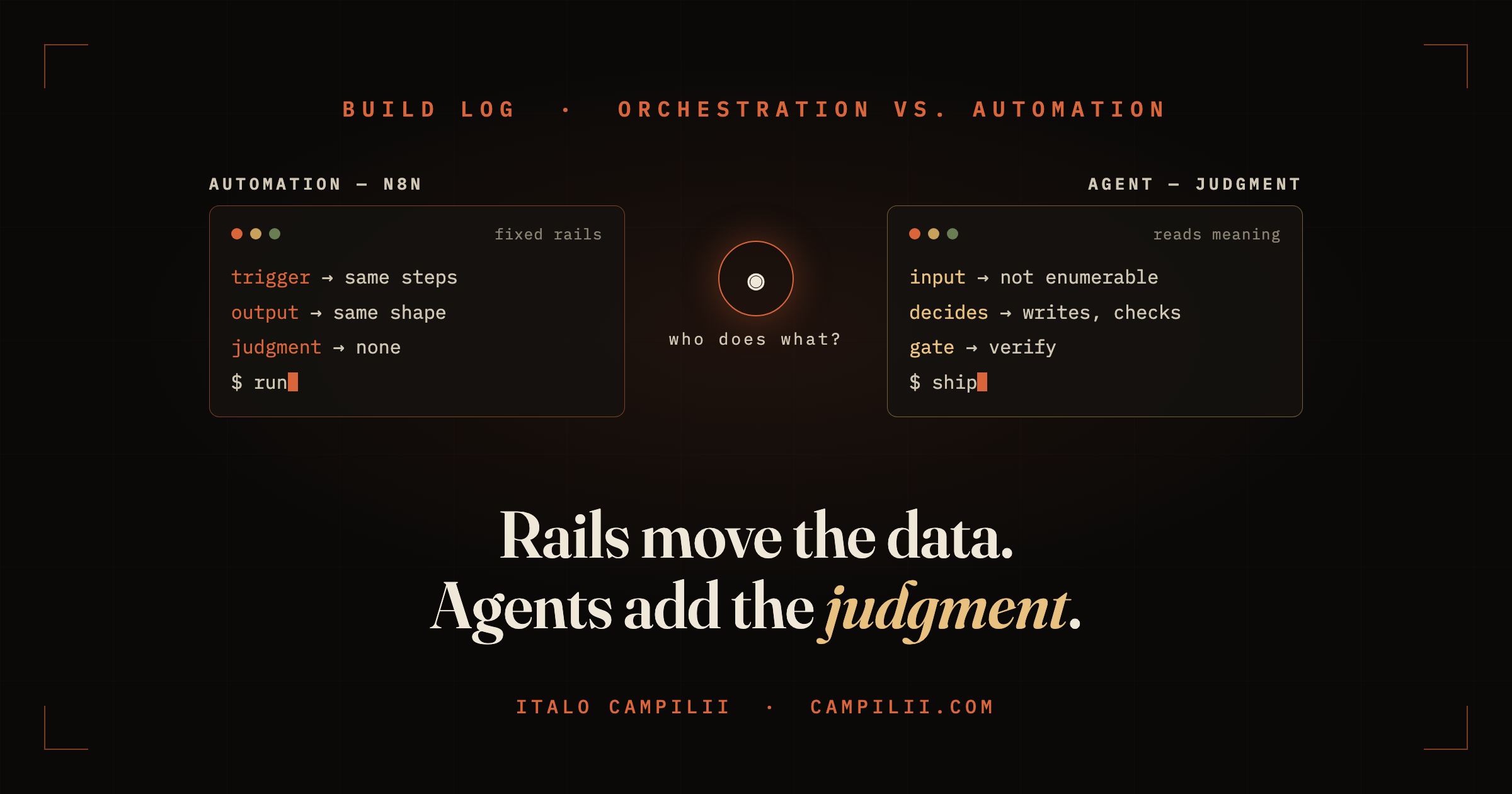
Automation (n8n, Zapier) moves data between apps on fixed rails: same trigger, same steps, same output shape, every time. Agents add judgment inside the pipeline: they write, decide, check, and adapt to inputs nobody enumerated in advance. Orchestration is the layer above both — the design work of deciding which jobs go to rails, which go to agents, and how the two hand off. You don't choose between them. The strongest pattern is composition: an agent produces the judgment-heavy artifact, and deterministic automation distributes it.
Most "n8n vs. AI agents" articles are written by people selling one of the two. I run both, daily, side by side: n8n automation fleets and Claude Code agent fleets are line items on the same infrastructure list, wired into the same brands. So this is a working definition of AI agent orchestration vs. automation from someone who has to decide, several times a week, which tool a new job goes to — and who pays for it when the choice is wrong.
Three definitions, no hedging#
Trigger-action automation is deterministic plumbing. A trigger fires (webhook, schedule, new row, new order), a fixed sequence of steps executes, data moves from system A to system B, possibly transformed on the way. n8n, Zapier, Make — the tools differ in ergonomics, not in kind. The defining property: every path through the workflow was drawn by a human before it ever ran. The machine executes; it never decides.
An AI agent is a language model given a goal, tools, and operating procedures, which then chooses its own steps toward that goal. It can read a messy input, judge what it means, produce novel output, notice something is off, and change course. The defining property is judgment inside the pipeline: the path through the work was not fully drawn in advance.
Orchestration is the layer that assigns work across both. It's the schedule that wakes agents up, the procedures that keep them on-spec, the handoff points where agent output enters deterministic rails, and the verification gates between every stage. Orchestration is not a product you buy; it's the operating design. When I describe running five brands' infrastructure solo, orchestration is the actual job — the agents and the workflows are just the workforce. I've written up the full shape of that in one person, five brands, AI agent fleets.
The common confusion is treating these as three sizes of the same thing — as if an agent is "advanced automation" and orchestration is "a lot of automation." They're different axes. Automation is about repetition without labor. Agents are about judgment without labor. Orchestration is about assignment: routing each unit of work to whichever executor fits it.
The boundary line: enumerable paths#
Here's the test I actually use when a new job lands on my desk. Ask one question:
Can I enumerate every path through this work in advance?
If yes — every input shape known, every branch drawable, every output identical in structure — it's an automation job, and putting an agent on it is waste. You'd pay model costs and accept non-determinism for a job a fixed workflow does faster, cheaper, and with zero drift.
If no — the input is language, the output requires composition or judgment, the edge cases can't be listed — it's an agent job, and putting n8n on it produces the uncanny garbage of template logic pretending to think.
Concrete examples from my own stack, both directions:
Jobs I give to n8n-class rails: moving form submissions into a database, firing notifications on new orders, syncing records between platforms, scheduled fetch-transform-post loops where the transform is mechanical. The paths are enumerable. Nothing in the job benefits from a model's opinion.
Jobs I give to agents: writing GEO-optimized articles inside a content engine, auditing a page against a checklist and deciding what's actually wrong, triaging inbound email by what it means rather than what it matches, producing ad creative grounded in verified product truth. The paths are not enumerable. A fixed workflow can't do the middle of these jobs at all.
Jobs that need both: most valuable pipelines, honestly. Which brings us to composition.
How they compose: agent writes, rails distribute#
The pattern that took me longest to name, and that I now reach for first, is this: the agent produces the artifact; deterministic automation moves it.
My content engines are the cleanest example. An agent — running on a schedule, governed by written operating procedures — researches, writes, and structurally verifies an article. That's the judgment half; no fixed workflow could do it. But everything after the artifact exists is rails: build the HTML, regenerate the sitemap and feed, publish, distribute. Those steps are identical every single run, so they're scripted and scheduled, not reasoned about. The agent never touches distribution; distribution never makes decisions. Each layer does the only thing it's good at.
That division isn't aesthetic — it's what makes the system trustworthy. Deterministic rails fail loudly and identically, so they're easy to monitor. Agents fail creatively, so they need verification gates before their output reaches anything real. Putting the judgment step behind gates and keeping the distribution step deterministic means the blast radius of a bad agent run is one artifact, not a broken pipeline.
The inverse composition exists too: rails in front of agents. A webhook catches an event, normalizes the payload, and then hands it to an agent for the judgment step. Automation as the nervous system, agents as the cortex.
Comparison: automation vs. agents vs. orchestration#
| Trigger-action automation | AI agents | Orchestration | |
|---|---|---|---|
| What it is | Fixed steps executed on a trigger | A model choosing steps toward a goal | The layer assigning work across both |
| Representative tools | n8n, Zapier, Make, cron scripts | Claude Code, agent frameworks | Schedules + procedures + handoffs (design, not a product) |
| Handles | Enumerable paths, structured data | Open-ended inputs, judgment, language | Assignment, sequencing, verification |
| Determinism | Full — same input, same output | None guaranteed — needs gates | Deterministic skeleton, non-deterministic muscles |
| Marginal cost per run | Near zero | Model tokens, real money at scale | Mostly design time up front |
| Failure mode | Loud and identical — easy to monitor | Quiet and creative — drift, fabrication | Bad assignment: agents on plumbing, rails on judgment |
| When it's the wrong tool | Anything requiring reading or writing meaning | Anything a fixed workflow does identically every time | Never — but it can be done badly |
Read the failure-mode row twice, because it's the operational heart of the comparison. Automation failures page you. Agent failures publish. That asymmetry is why the orchestration layer earns its keep: it's where the verification gates live, and where the schedule lives — the part that makes agents work while you sleep instead of only while you watch.
Is n8n an AI agent platform now?#
Worth addressing directly, because n8n itself has been adding AI nodes and agent features, and the marketing blurs the line I just drew. You can drop an LLM call — or a whole agent node — into an n8n workflow today.
My operator's read: that doesn't change the categories, it just relocates the boundary inside one canvas. An LLM step inside a fixed workflow is a judgment node on deterministic rails — genuinely useful for contained judgment (classify this, summarize that, extract these fields), and I use the pattern. But a contained judgment step is not the same animal as an agent fleet that owns a whole function end to end, operates from written procedures, uses a terminal and a filesystem, and runs on its own schedule. The question that separates them is scope of ownership: does the model make a decision inside your pipeline, or does it own the pipeline's output? The first is automation with a smart step. The second is what I mean by an agent, and it's the level at which an AI systems builder actually operates.
Do you need agents, or just automation?#
The honest answer most vendors won't give: start by assuming you need automation. If every job in front of you has enumerable paths, fixed rails will beat agents on cost, reliability, and monitoring — and you can be live this week. A shocking amount of "we need AI" is actually "we need a webhook and a schedule."
Reach for agents when the work itself is judgment: writing, deciding, auditing, adapting. And when you do, budget for the part nobody mentions — the operating procedures and verification gates that keep agent output trustworthy. In my experience the procedures are most of the work; the agent is the easy part.
Then, if you end up running both — and any operation of real scope eventually does — the skill that matters stops being either tool and becomes orchestration: knowing which executor each job belongs to, and designing the handoffs so judgment flows into rails cleanly. That's the layer where one person starts doing the work of a department, which is the entire thesis of this site.
FAQ#
Is n8n an AI agent?#
No. n8n is a workflow automation platform — fixed steps on triggers. It now offers AI and agent nodes, which put a model's judgment inside a workflow, but a contained judgment step inside deterministic rails is not an autonomous agent that owns a function end to end. The distinction is scope: a smart node makes one decision inside your pipeline; an agent owns the pipeline's output.
Do I need AI agents or just automation?#
Apply the enumerable-paths test: if you can draw every path through the work in advance, use automation — it's cheaper, deterministic, and easier to monitor. If the work requires reading meaning, writing, or judgment on inputs you can't enumerate, you need an agent, plus verification gates around it. Most mature operations need both, composed.
What is AI agent orchestration?#
Orchestration is the layer that assigns work across automation and agents: the schedules that trigger runs, the written procedures that keep agents on-spec, the handoff points where agent output enters deterministic distribution rails, and the verification gates between stages. It's operating design rather than a product — the difference between owning some tools and running a system.
Can n8n and AI agents work together?#
Yes — that's the strongest pattern. The cleanest composition is agent-writes, rails-distribute: an agent produces the judgment-heavy artifact (an article, an audit, a creative asset) behind verification gates, then deterministic automation handles the identical-every-time steps of building, publishing, and distributing it. The inverse also works: automation catches and normalizes events, then hands them to an agent for the judgment step.
Which is cheaper to run, automation or agents?#
Automation, by a wide margin, per run: a fixed workflow's marginal cost is near zero, while every agent run spends model tokens. That's exactly why the enumerable-paths test matters — putting agents on plumbing burns money for no added judgment, and putting rails on judgment work produces output no one can use. Price each job by what it actually requires.
RELATED
Not sure which side of the line your workflow sits on?
Bring me the workflow. I'll tell you in one call whether it's a rails job, an agent job, or a composition — and if you want it built, I ship working, verified pipelines. Get in touch.
— Italo Campilii. If you're building something that needs this kind of operator, get in touch.